Showing posts with label politics. Show all posts

15 January 2012

"[G]athering up a knowledge of all the...sufferings and abuses put upon them...."

"And again, we would suggest for your consideration the propriety of all the saints gathering up a knowledge of all the facts, and sufferings and abuses put upon them....And also of the all the property and amount of damages which they have sustained, both of character and personal injuries, as well as real property; And also the names of all persons that have had a hand in their oppressions, as far as they can get a hold of them and find them out.  And perhaps a committee can be appointed to find out these things, and to take statements and affidavits; and also to gather up the libelous publications that are afloat; And all that are in the magazines, and in the encyclopedias, and all the libelous histories that are published, and are writing, and by whom, and present the whole concatenation of diabolical rascality and nefarious and murderous impositions that have been practised upon this people—That we may not only publish to all the world..." (Doctrine and Covenants 123:1-6)
 Like just about anyone who follows politics closely, I spent the week parsing the results of the New Hampshire primary and its implications for the upcoming South Carolina primary this coming week.  Until now, the conventional wisdom has been that Mitt Romney, a Mormon, could never win in the South.  The politico-religious climate dominated by evangelical Christians was simply too inhospitable, and until not so long ago, downright violent (as discussed in Patrick Mason's excellent book).  Now, some polls are showing Romney with a growing lead in SC, and it is flipping that conventional wisdom on its head.

Some observers, and I count myself among this number, have been surprised at how much the Mormon issue has not been a factor in this primary season.  Granted that conservatives have had plenty of other complaints to make about the frontrunner, no matter their failure to make the charges stick.  Nevertheless, seeing as how a large group of evangelical pastors and religious leaders met this past week to discuss solidifying behind a single not-Romney candidate, my suspicions are that the more ecumenical stage of the race is over.  (Those leaders denied that Romney's Mormonism was a major point of discussion at the meeting, but if you believe that, I have a proverbial bridge to sell you)  Not to mention that South Carolina is a state notorious for its dirty campaigning.

As quoted above, in 1839, while imprisoned in Missouri, Joseph Smith sent a letter to his followers instructing them to keep a historical record of the persecutions that they suffered.  Its an idea that I would like to see revived during the 2012 election season, particularly in the South.  First a disclaimer:  I am not interested in grievance-mongering (a la the ADL) and this is certainly not an exercise in taking names for retribution (divine or human) later, as one portion of the above-quoted text might suggest.  In fact, my preference would be that names are excluded from any publication.  I am in full agreement with Joanna Brook's idea that the LDS persecution complex is somewhat overblown and that LDS need to work on a different response to such negativity than a reflexive hand-wringing and finger-pointing.

That disclaimer aside, the purpose of the organization I am envisioning would simply be to catalog and organize incidents or manifestations of anti-Mormon sentiment in South Carolina.  Ideally, the focus would be kept local, rather than statewide.  Its far less important to me to find out what one of the other candidates or their surrogates said at a campaign rally, than to have some record of that conversation you overheard in the local diner, that letter to the editor in a small-town newspaper, or the Sunday sermon in a prominent local church.  Reporters will catch some of this, but most journalists: a) have no particular personal interest in this issue, and b) have a million other aspects of the race that need to be addressed in limited time and on deadline.  The organization should be a loose confederation of part-time volunteer individuals, independent from the LDS Church, creating and organizing a joint database, which could eventually be shared publicly (preferably online).

The 2012 election is an almost perfect natural experiment, and not one that is likely to reoccur in the near future.  This research could eventually be used by scholars a hundred years from now to build on the work that Patrick Mason did in the book I linked to earlier.

Author's Note: I swear I am not writing about Mitt Romney and the election every week, but it is the hot issue right now, so a more diverse reading experience will be coming your way soon.
_____________________________________
The Nightstand (January 8-14)


- How Large the Huddled Masses?: The Causes and Consequences of Public Misperceptions about Immigrant Populations (John Sides and Jack Citrin)- see also Sides' follow-up at the American Prospect and the Climate Progress series on the Debunking Handbook.  What these articles represent to me is not confined to the issues of immigration or climate change, but a meta-issue of whether giving more (or better) information to people can help change their political opinions.  This is a naturally liberal and optimistic view of human nature, but probably mistaken in my opinion.  This approach neglects the importance of a priori values in filtering the information that they will accept, and the fact that some people simply are not persuaded by the "facts" as much as they are by the "truth."  It seems pretty hopeless to me.

- Giving Advertising its Due (Ezra Klein, WaPo Wonkblog)- on the convergence of news, information, and advertising (particularly online)

- Why Is Inequality Higher in America? (Henry Farrell, The Monkey Cage)- An interesting take on comparative political structure (rather than more directly economic factors) as a key cause of inequality.

- And for a less thoughtful take on inequality, see Mitt Romney's statement discussed by Matthew Yglesias here.

- The Next Immigration Challenge (Dowell Myers, NYT Op-Ed)- Illegal immigration to the US is growing of a rate of about....zero.  Now what to do to assimilate those already present.

- Arthur Brisbane and Selective Stenography (Glenn Greenwald, Salon)- Going forward, let's just assume that something Greenwald writes will be worth including here each week.

- Lockdown: The Coming War on General-Purpose Computing (Cory Doctorow, boing boing)- Cory Doctorow weaves copyright, SOPA, and the fragmentation of the human-electronic experience together.

- The Rise and Consequences of Inequality (Alan Krueger)- This link will direct you to a set of slides from this presentation by the Chairman of the White House Council of Economic Advisors.  Mostly just graphs and they should be self-explanatory.

- Israelis Facing a Seismic Rift Over Role of Women (NYT)- From the front lines of a ridiculous fight between minority religious prerogatives and secular rights.

- We're all guilty of dehumanizing the enemy (Sebastian Junger, WaPo)- If you have not seen it yet, time to watch "Restrepo".

- Making It in America (Adam Davidson, The Atlantic)- If you don't want to read the whole thing, just listen to the recent Planet Money episode that covers the same ground.

26 July 2011

The Debt Ceiling and Collective Punishment

There is a strong (and growing) chance that, barring an epidemic of reasonableness breaking out in the nation's capital, the US will default on its debts sometime in early August, perhaps as early as a week from today.  At that point, the government will not be able to meet all of its financial obligations, including interest payments on the debt, Social Security payments, Medicare reimbursement, etc.  However, it will continue to be able to meet some of those obligations.  Therefore, one effect would be that the President and his administration would have to prioritize certain kinds of payments that would be made first, while other types of payments may not be made at all.

As long as priorities have to be set, I would like to see the following: instead of cutting of Medicare, Social Security, military salaries, etc. entirely, let's cut them only in those states whose Senators will not support a clean debt limit hike.  Every state has two Senators (that makes assigning responsibility easier than by representation in the House of Representatives, which varies widely by state), so if both your Senators support, or reject, a debt ceiling hike, you get 100%, or 0%, respectively, of whatever money the federal government is able to set aside for those purposes.  If your state is split, you get 50%.  (Using Senators instead of Representatives also makes the math easier)  Its pretty well-established that many, if not most, of the states whose Senators will likely reject a clean debt ceiling hike are government spending mooches, so they have even more to lose.1

Its a form of collective punishment.  Likely nothing will persuade citizens to move their Senators (and Representatives) to support debt ceiling increases, or moving said leaders out of office, than depriving them of  their increasingly invisible government benefits.  Someone might argue that what this proposal really does is hurt the poor and the vulnerable who are dependent on these benefits, a charge to which I am particularly sensitive.  However, when the choice is between depriving all of the poor, or depriving only a portion of the poor (and a disproportionate number of the white rural poor who voted Republican at that), I would almost always choose the latter.  But, as the cliche goes, elections have consequences, and they ought not to just have consequences for the ruling class, but for those that elect them.

I'm fully aware of how politically infeasible this kind of proposal would be.  Collective punishment is a violation of the Geneva Conventions and the laws of war, and after all, politics is war by other means (Joe Klein on Gingrich in the New Yorker).  Any President who tried it would be committing electoral suicide for him/herself and their party, since any swing state that was deprived would henceforth cease to be a swing state.  But one can dream...

______________________________________________
1 I am presuming for the purpose of this post, and I think with good reason, that a "clean" debt ceiling vote would break down on predictably partisan lines, with Democrats voting for and Republicans voting against.  That means that NC (where I grew up) gets 50% of its payments, Texas (the state in which I currently reside) gets nothing (as does Utah, where many family members reside), while NY and CA would get 100%.

18 April 2011

Two recent religion book reviews

My wife encouraged me to add more book reviews to my blogging habits, so I thought I would give that a try.


Just wanted to add two quick book reviews here-

The first is American Grace: How Religion Divides and Unites Us by David Campbell and Robert Putnam (of Bowling Alone fame).  So much has been written about this book elsewhere, that I do not have anything to add to the conversation-- other than that it has my unequivocal recommendation.  The authors do an incredible job of weaving sociological and statistical insights with detailed on-the-ground observations and vignettes that give the text a very complete scope.  For a book that relies heavily on statistics, it is remarkably easy to read.  I have neither seen nor heard of another such accessible text that gives such a good picture not just of where American religion is today, but where it is going.

The second book is The Myth of American Religious Freedom by David Sehat, a historian at Georgia State University.  While I also liked this book, I would add that it is mis-titled.  The title should have been A History of How Religious Persons Violated Other Americans' Freedom, which after all, is a pretty good title for a book, and could have been one quite a bit longer than this one, weighing in at a slim 294 pages.  The author sets for himself the purpose to explode myths of religious freedom on both the political left and the right-- first, that there is and has been a strict separation (or wall) between church and state and secondly, that religion is indispensable, both then and now, to the preservation of American freedom.  (Sehat also adds a third myth- the myth of religious decline, meaning that religion was once important to the American project, but has ceased to be so).  It strikes me that the first myth is an essentially historical question (Did the Founders establish a wall between church and state?), while the second represents a question of analysis that will necessarily evoke value judgments about the nature of "religion" and "freedom."  Though the two questions do not quite stand directly on par, the author gets credit for achieving the goals that he has set out for himself, though in a way that will undoubtedly be more pleasing to partisans of one side more than the other.

Sehat traces the history of American religious conduct since prior to the American Revolution up to the present time, purportedly by examining the stories of those who fell outside of the religious mainstream.  This is a kind of historical reading, though the eyes of dissenters, pioneered by Howard Zinn and others, and I thought more could have been done with it here, particularly with non-Christian Americans.  He manages to disprove the liberal myth of separation by identifying and examining the persistent influence of something he terms the "moral establishment," which is a loose group, changing in composition over time, but generally representing the mean of American religious life.  At the same time, the myth of religion's contribution to the progress of freedom is disproven by simply showing what a nasty piece of work the moral establishment was (and is), due to its reliance on, as the author terms it, "coercion" rather than more democratic means of "consensus."

The truth as Sehat recognizes it is that religion has consistently been tied into American history, politics, and society, but most frequently to the detriment of American freedom.  Here we miss what would have been a worthwhile leap out of the straight historical narrative of is (or was) and into the ethical framework of ought, a leap with which I understand some historians are predictably uncomfortable.  But the question remains worth asking: should a more solid separation of church and state been enforced? (which is to say nothing of who or how it would have been enforced, given that large portions of the most powerful institutions in American life either constituted or were heavily dominated by, the moral establishment)  Or likewise, what should have changed about American religious practice to make it a more positive contributor to American freedom?

Looking to this latter question, one area I would like to see further research and analysis is the capitalist-industrial-evangelical fusion in the late 19th and early 20th centuries, wherein large portions of the moral establishment acquiesced in and promoted the demands of capital over and against labor, and took the side of the mighty property owners against the working class.  Can we imagine an alternative form of the moral establishment which took the rights of labor and the welfare of the working class as a guiding principle?  Roman Catholicism did this, but at the time, as a minority under suspicion, it did not yet form part of the moral establishment.  Likewise, there are plenty of examples of religious communities operating under principles of religious socialism or collectivism (e.g. the Mormon United Order, the Oneida Community, the Amana colonies), but none achieved size or longevity of any kind and most were later subsumed by the capitalist hegemony.  What religious tenets or other accidents of history needed to change to create a group that could have served this purpose?

Despite feeling that Sehat could have gone farther (and that it was somewhat misleadingly titled), The Myth of American Religious Freedom is still a worthwhile read, particularly in an age such as our own, shot through with religious conflict, bad history, and Founder-worship.

02 January 2011

Recalculating Eisenhower

In April 1953, President Dwight Eisenhower gave a speech entitled "The Chance for Peace" before a group of journalists and newspaper editors.  In that speech, he said the following: 


"Every gun that is made, every warship launched, every rocket fired signifies, in the final sense, a theft from those who hunger and are not fed, those who are cold and are not clothed. This world in arms is not spending money alone. It is spending the sweat of its laborers, the genius of its scientists, the hopes of its children. The cost of one modern heavy bomber is this: a modern brick school in more than 30 cities. It is two electric power plants, each serving a town of 60,000 population. It is two fine, fully equipped hospitals. It is some 50 miles of concrete highway. We pay for a single fighter plane with a half million bushels of wheat. We pay for a single destroyer with new homes that could have housed more than 8,000 people. This, I repeat, is the best way of life to be found on the road. the world has been taking. This is not a way of life at all, in any true sense. Under the cloud of threatening war, it is humanity hanging from a cross of iron."
Coming across this quotation several days ago, and thinking back to my previous post on the federal budget, I wondered how Ike's comparisons would hold up in 2010.  As I alluded to in that post, American defense spending sums to more than half of all the defense spending worldwide.  That means that the United States alone spends more on its defense and military than all the other nations of the world...combined.  Let's take a look at the numbers:


  • "One modern heavy bomber"- Northrup Grumman B-2 Spirit (the "stealth bomber")- total program cost (avg./aircraft) - $2.87 billion in 2010 dollars.
  • "Modern brick school"- average cost to build a high school in 2008- ~$20 million.  Furnishing and staffing the school would cost about half this again, so we'll work with a figure of $30 million.  That works out to 95.67 modern high schools for each stealth bomber, of which the United States has 20 in active service.  That works out to nearly 2,000 brand new schools merely for those bombers currently in active service.
  • "Electric power plants"- recent estimates from different parts of the country put the cost of a new coal power plant generating sufficient energy to power 150,000 homes would cost $1 billion.  So instead of 120,000 homes in Ike's day, two modern coal plants would power over 300,000 (per plane).  It should be said that nuclear plants cost considerably more, equivalent to 3 or 4 such bombers.
  • "Fully equipped hospitals"- a recently constructed modern hospital in Waco, Texas cost approximately $32 million to build.  Staffing and equipping a modern hospital obviously costs a great deal more than the school, but even assuming a total cost of $100 million, a single B-2 bomber would buy nearly 30 such hospitals.
  • "Concrete highway"- to build a six-lane Interstate freeway costs between $7-$12 million per mile (less extensive roads can cost less than $1 million per mile in some states).  Even taking the high estimate, you could build almost 240 miles of interstate highway.  Perhaps more importantly, the average cost to construct a mile of light rail in the United states is $35 million.  That's 80 miles of light rail, or the length of my daily commute to and from Houston twice over.
  • "Fighter plane"- the new F-35 Joint Strike Fighter costs approximately $89 million.
  • "Bushels of wheat"- worldwide, wheat prices are about $6 per bushel.  That works out to about $3 million for Eisenhower's half million bushels.  For $6, that gets us about 500 million bushels of wheat.  To make this a more useful figure, for each F-35, of which the military plans to buy more than 2,000, we could buy every man, woman, and child in America one and a half Big Mac extra value meals.
  • "Destroyer"- each of the Navy's new Zumwalt-class destroyers is estimated to cost about $3.3 billion.
  • "New home"- For the price of the average new home sold in the United States in October 2010 (cost $248,000), that means we could build over 13,000 such new homes.  For an average family, that means housing nearly 40,000 people, a fivefold increase from Eisenhower's day.


Obviously, none of the above makes the United States' amount of military spending self-evidently excessive, nor establishes that the alternative expenditure is more worthwhile.  But, as President Eisenhower pointed out,  every penny that we dedicate to building something for the military could have been spent in other ways.   Over the next few years as we hear the inevitable back-and-forth of deficit reduction, I expect that we will hear the words "non-defense discretionary spending."  The implicit assertion behind this concept is that we spend Monopoly money on the military, but real dollars on everything else.  Nobody actually believes that, but it is not until we attempt to lay out the opportunity costs of all those planes, ships, and guns, that it becomes more clear what a "theft" it represents.

12 December 2010

The Filibernie of 2010

What words can one possibly add to Senator Bernie Sanders' epic not-really-a-filibuster this past Friday? Since it went on for eight and a half hours, not much.  No doubt that it was a terrific piece of political theater, unlikely to shape any substantive policy (but for the purest example of political theater imaginable, see Bill Clinton's appearance in the White House briefing room at approximately the same time).  I am however, utterly disappointed in the lack of media coverage the speech attracted after the fact.  For one rare moment, Senator Sanders managed to break through the corporate PR-speak talking points that have become the stock in trade of both political parties, and spoke the truth to power about the miserable inequality and injustice in the American political and economic system.  If you missed the speech (broadcast live and in its entirety on CSPAN, which practically guarantees that everyone missed it), and gathered your news from the 24-hour cable networks and a couple of prominent national newspapers the next day, you would hardly have been able to detect any trace that someone had given a speech that lasted almost the entire workday of most Americans.  Where was the thoughtful analysis of Sanders' bold claims?  Where was the counter-evidence?  Is the system really as bad as he says it is?  Or is he just some old crank rattling off a bunch of misleading and meaningless figures? As with all stories that don't quite fit with the media's preferred simple left-and-right narrative, or which discomfits the corporate overlords, it is best that such things are simply forgotten, now and forever.

10 October 2010

The Federal Budget Game

Recently this article by scholars at Harvard Business School and Duke University has been getting a lot of attention.  Its not a long article, so by all means, read it in its entirety.  The gist of the article is that, based on a survey of a representative sample of over 5,000 Americans, Americans have no clue about the present state of wealth (not income) inequality in this country, but also that their desired distribution of wealth differs vastly from reality (in fact, Americans would find the distribution of wealth in Sweden to be most agreeable).  While the first conclusion is worrying, the second is generally heartening.  The fact that more people approve of a more equal distribution of wealth ought to be celebrated.  However, survey results cannot confer on any distribution of wealth the status of "true," "fair," or "right."  More robust ethical reflection is necessary to determine such things.  Nevertheless, studies like these are not without utility.  They show us what people believe, but more helpfully, suggest why they may act in certain ways or promote certain policies.  This is particularly interesting when a group's erroneous views may contribute to a lack of support for rational policymaking.

I thought that it might be a useful experiment to apply similar techniques to government spending, and in particular the U.S. budget.  What I have laid out below are two quizzes, or rather one quiz and one survey.  The quiz asks how much of the federal budget is allocated to specific programs.  The survey asks, if you had total budgetary discretion, how much of the federal budget you would allocate to those same programs.  Please take both but follow the instructions carefully and complete both the quiz and the survey before looking at the answers to the quiz itself.  The effect is ruined if you see the answers before taking the survey.

First, the basics.  President Obama's requested federal budget for Fiscal Year 2011 is estimated to be $1.415 trillion dollars.  This includes only discretionary spending, meaning that the President and/or Congress can change the amount allocated for each program or department from year to year.  That figure does not include mandatory spending, or programs which must be paid out (i.e. entitlements), which consists primarily of Medicare/Medicaid, Social Security, other income security programs (unemployment, food stamps), interest on the national debt, etc.  Many of these mandatory programs are not paid for through general income taxes, but through other forms of taxation.  With those categories included, the federal budget is $3.69 trillion.  The estimated deficit appears to be nearly the size of the entire discretionary budget; or about $1.3 trillion dollars.  I have not included every category of discretionary spending, so you should not expect the numbers to add up to 100%.  Please don't cheat by looking these numbers up elsewhere.  The point is not to test what you know, but to see what you think.

The answers to the quiz are embedded in the post itself.  However, the text is blacked out so you have to highlight it in order to see it.  Obviously, this is not a real research study.  It is mostly for fun, but also to make a point, which will be discussed below.  If you want to share, feel free to leave your answers in a comment below. 

1.  What percentage of the federal discretionary budget do you believe is spent in the following discretionary categories?

a.  Defense/national security (Overseas operations, soldiers, equipment, etc.)- 63%
b.  Foreign aid - <1%
c.  Housing/Urban Development- 4.5%
d.  Education (includes grants to states) - 9.9%
e.  Federally funded research and development* - 10.4%
f.  Transportation (highways, rail)- 7%
g.  Governmental salaries- 1.4%

* This number includes some defense-related research; therefore, there may be some overlap between this category and the defense/national security category.

2.  What percentage of the overall federal (discretionary and mandatory) budget do you believe is spent in the following mandatory categories?

a.  Medicare- 13.5%
b.  Medicaid grants to states 7%
c.  Unemployment - 2%
d.  Food stamps- 2%
e.  Social Security retirement/disability - 20%

3.  What percentage of the discretionary federal budget do you believe should be allocated to the following priorities?

a.  Defense/homeland security
b.  Foreign aid
c.  Housing/Community Development
d.  Education
e.  R&D
f.  Transportation
g.  Government salaries

4.  What percentage of the overall federal budget do you believe should be allocated to the following priorities?

a.  Medicare
b.  Medicaid grants to states
c.  Unemployment
d.  Food stamps
e.  Social Security retirement/disability
.
.
.
.
.
Please leave your answers before reading below.
.
.
.
.
.
.
Simply put, the point of this post is that anybody who tells you that they want to eliminate or significantly reduce the deficit by cutting non-defense discretionary spending is a know-nothing hack.  Nearly 60% of the overall federal budget comes from four areas: Medicare, Medicaid, Social Security, and defense-related programs.  Of course, the reason that these budget line items were allowed to get so big in the first place is because there are interested parties and lobbyists pushing for more spending in these areas.  And so cutting them is more difficult than budget cuts in many other areas which are not quite so large.  Nevertheless, it is plainly foolhardy to believe that we can eliminate a deficit of the size of nearly the entire discretionary budget (more than 33% of the overall budget) by attacking only 40% of the overall budget.  (And at the same time when we maintain a military that spends more than all of the other militaries of the world combined.)

Also, Americans' favorite choice for significantly reducing federal spending? Foreign aid.  Of course, it is hard to see how we could spend less on this, and even have it show up in the budget.  The Economist survey to which I linked does not list government salaries (particularly those of the legislative branch) as an option for spending cuts, though I am certain that if it were, it would come in a close second, if not first.

As I pointed out in my initial paragraph, none of this information, nor your answers to the above questions, can tell us what is the "right" or "perfect" federal budget.  It is likely that many fair allocations exist.  Nevertheless, it is even more likely, if not practically certain, that the current allocation is suboptimal, and not simply for the fact of spending too much on everything.  My greater purpose here was to see if people could imagine more useful and prudent spending if they were provided with sufficiently complete and objective information about how our money is currently spent.

Some links- Death and Taxes; NYT Budget Graph
Note: I gathered budget data from several different sources.  If there are problems in the way I have calculated percentages, I will gladly correct them if pointed to a better source.  It is not easy to get simply, straight-forward information about this subject, which of course, is part of the problem in the first place.  One of the chief problems is that different sources define spending categories differently, and some calculate percentages based on overall budget, while a few look at the discretionary budget.  I have tried at the very least to be internally consistent, but I cannot claim infallibility.

01 August 2010

Two "Ticking Time Bombs" - Deficits & Unemployment

Warning: There will be a lot of links in the post below.  I am going for the "full Greenwald."

On Friday evening, my wife asked me what I was planning on doing this weekend.  My reply was "As little as possible."  These days it seems like that is exactly what the GOP has planned to do with existing budget deficits and the unemployment that will handicap the United States for the foreseeable future.

The big upcoming budget fight for the rest of this year, and probably into the next Congress, will be whether, or to what extent, the "Bush tax cuts" ought to be extended.  Good estimates from the Committee for a Responsible Federal Budget find that a full extension of the tax cuts will add $3.28 trillion to cumulative deficits between 2011 and 2018.  Alternate proposals would include allowing the tax cuts to expire only for those Americans earning more than $250,000 per year but extending them for those making less than that.  As pointed out this morning by William Gale in the Washington Post, the Bush tax cuts are estimated to account for approximately 25% of the budget deficit this year.  That is not a majority, nor likely even a plurality of the budget deficit.  Other large line items contributing to the deficit include the TARP and Recovery Act measures (one-time expenses), and the wars in Iraq and Afghanistan (which will supposedly end sometime in the next ten-year budget window, but who knows?).  These are all on the side of tax expenditures, while the revenue side has certainly been reduced by the reduced taxable income and assets caused by the recession itself. Allowing all tax cuts to expire would have a more helpful effect on the immediate and long-term budget deficit; however, a large portion of the work can be done by allowing higher-income earners to bear the brunt of the increases.  Moreover, since the GOP wants to pretend that nothing was wrong with the Bush tax cuts in the first place, allowing any tax cuts to expire will be difficult politically.  Allowing all of them to expire, particularly in a time fraught with middle-class anxiety, is next to impossible, even if it was desirable.

While swallowing this deficit camel (Note: The idea that tax cuts "pay for themselves" or that they have a stimulative effect far in excess of their ultimate cost to the deficit, I find to be laughable.  At least four prominent conservative economists (as well as just about everybody else who knows anything about the problem), agree with me.), the GOP simultaneously strains at the gnat of additional stimulus (particularly in the form of extended unemployment benefits).  Unemployment benefits, extended even to periods of several years, are not threats to the long-term deficit.  Quite to the contrary, they are among the most effective forms of direct stimulus, as those without jobs are likely to spend nearly every dime they receive as unemployment benefits on basic necessities.  Even if unemployment benefits were a form of pure deficit spending, without any correlating stimulative effect, they would be the right thing to do, as I will explain shortly.  But to insist that a $3 trillion tax expenditure is no problem, while filibustering an extension of unemployment benefits with a cost of $33 billion smacks of a profound lack of seriousness about dealing with deficits.

The extension of unemployment benefits would be a priority of the second order if it were reasonably anticipated that prospects for employment were to improve rapidly in the short- to medium-term.  Such is emphatically NOT the case.  Estimates range anywhere from 5 to 11 years to restore employment to pre-recession levels.  While the long-term deficit is no doubt a ticking time bomb that will need to be tackled with some tough and courageous policies over the next decade and into the future, persistent high unemployment is a crisis RIGHT NOW and into the future.  More (and more targeted) short-term stimulus is one answer, with deficits being handled in the medium- to long-term.  For those of us not personally associated with someone with a long-term unemployment issue, the high numbers of the unemployment can tend to blur into mere statistics.  But the full cost of long-term unemployment is not something that can be appreciated solely on the basis of a GDP figure, deficit numbers, or the monthly U16 report.  The true costs of unemployment are a deterioration in the nation's stock of human capital, in the form of unrealized investments in education, training, etc.  Perhaps this is most profound for youth growing up in homes where one or both parents may be suffering from long-term unemployment.  Lack of savings for education and enriching experiences in one's youth cannot be easily regained once that youth is spent.  That means that the full and true cost of this recession will not be known until 15-25 years from now, when today's youngsters are entering the workforce in full for the first time.  One of the most important governmental priorities in this recession is to support education (i.e. by not forcing state budget cuts in education and teacher layoffs) and put money in the hands of families so that they can make their own investments in human capital.  That is why, aside from any stimulative effect it might have, it is imperative that Congress put the extension of unemployment benefits beyond the reach of short-sighted legislative maneuvers.  Ergo, unemployment benefits should be extended almost indefinitely, or at least until our unemployment figures hit a certain stable and acceptable floor (probably between 5 and 6 percent, 3% being defined as full employment).  At the same time, short-term measures to forestall cuts in education expenditures and further targeted stimulus must be put in place.

There can be no recovery in the broader economy without a recovery in employment as soon as possible.  Consumer spending and tax revenues will not get back to where they need to be until reliable and steady incomes can be put back into the hands of all of America's working populace.  In the meantime, the human cost of unemployment and resulting dislocations is too high to wait for the jobs to come back.

30 June 2010

Why I am not watching the Kagan confirmation hearings

Because I am an attorney and because I happen to love constitutional law, one might think that I would be glued to my television this week during the confirmation hearings for Elena Kagan to be appointed as a justice on the Supreme Court. However, nothing could be farther from the truth. I will read the daily dispatches in the New York Times and might catch the soundbites on CNN, but I can think of a list longer than my arm of things more worth my time.

As Kagan has herself pointed out, these hearings are "vapid and hollow charade." The Senators are going to repeat partisan talking points that bear little relation to the complexities of constitutional law and the nominee will say just enough to be confirmed but no more. As others have emphasized, these hearings ought to work as a civic event to educate the public regarding constitutional interpretations and the content and progress of our civic freedoms. However, it is hard to see how an environment where both participants are just trying to score points is conducive to educational outcomes. At first glance, this does not appear to signal that the Socratic dialogue between professor and student in a law school would be educationally useful, but having been there myself, I think that most students (and probably most professors) are simply trying not to look stupid or unprepared. However, in the present case, I do not think that anyone believes that Elena Kagan is stupid. From all reports, she seems to have been consciously preparing for this moment her whole life; she is unlikely to screw it up now by saying something risky. And on the other side, I do not think that the Senators will be able to say anything that will convince me that half of them are not complete morons.

McChrystal's Firing

Another unanticipated break from blogging. My ongoing intention has been to post more regular and briefer posts, and in a more timely fashion than I have traditionally been accustomed to. So tonight, I am actually going to start that project and have two posts for your reading pleasure.

Last week, President Obama relieved Gen. Stanley McChrystal of his command over American forces in Afghanistan, following revelations from this Rolling Stone article. McChrystal's various disparaging remarks regarding members of the Administration, including the President himself, are well known and do not need to be repeated here.

In the days and hours leading up to the announcement of Gen. McChrystal's "firing" and replacement with Gen. David Petraeus, I felt ambivalent about letting him go. On the one hand, he had clearly committed a misdeed worthy of the punishment he received. The Constitution clearly establishes the principle of civilian control of the military. If one of the privates or captains in Afghanistan had made similar disparaging remarks to a newspaper regarding Gen. McChrystal, he would have been discharged immediately. One simply does not criticize or complain about superior officers to the press or the public. And in this case, the President, as commander-in-chief, is everyone's superior officer. Some may worry that this deprives those who serve in the military of some measure of their First Amendment freedom of speech. Technically that is true, and such deprivation has been accepted as one of the costs of enlisting in the military. However, no one is insisting that Gen. McChrystal must like President Obama and the members of his foreign policy team, or that he cannot criticize them vociferously in private. However, once he stepped over the line by repeating those criticisms to a journalist, he has made himself the focus of and an obstacle to the mission, the ultimate no-no for any soldier, no matter what rank.

On the other hand, I am personally tired of the seeing this pattern: member of political (or military) leadership commits very public and very embarrassing gaffe, he or she is fired or "resigns", we all pretend that the problem is solved. The McChrystal incident is not a perfect illustration of this problem, because the norm which he violated is so well-understood and so dangerous if transgressed. Nevertheless, his criticisms go to the heart of the problems with the ongoing wars in Iraq and Afghanistan-- military leaders (I believe) understand what our political leaders sometimes fail to, that victory, in any form that would be immediately recognizable to Americans is simply not going to happen in these conflicts. On the negative effects that the prolonged state of war is having on our military personnel, I highly recommend this great op-ed by Andrew Bacevich in the Washington Post. The problem in general is that when one of these embarrassing statements or mistakes is made, no serious conversation regarding the merits is generated. The resignation or firing is a purely face-saving move, but one that leaves the government temporarily disrupted and crippled until a suitable replacement can be found. We need to have that conversation about Afghanistan, not to mention 10 or 20 other issues. We ought to be able to rely on journalists to generate this kind of discussion, but they are increasingly unable or unwilling to challenge or diverge from the self-serving narratives that emerge from Washington. And so the disgraced shuffles off into the shadows, only to reemerge shortly thereafter with a new lobbyist position or a generous pension (as in McChrystal's case). Its pointless, if not counterproductive, and we need to find a better way to deal with these types of situations as a government, but more importantly as a public.

10 January 2010

Reid's faux pas - much ado about nothing

The weekend's big political story has been the controversy surrounding Senate Majority Leader Harry Reid (D-NV)'s unfortunate remarks regarding then-candidate Barack Obama's race during the 2008 presidential campaign, as reported in Mark Halperin's new book. According to Halperin's book, Senator Reid stated that America would be more receptive to Obama as president because he was "light-skinned" and did not have a "Negro dialect." The new Republican attack wants to demand that Reid be treated the same as former Majority Leader Trent Lott, who was forced to resign after he commented that the country would have been better off had it elected segregationist candidate Strom Thurmond in 1948 and avoided all its subsequent problems. See Josh Marshall's take here, as I think he has hit the nail on the head.

This is a purely false and specious equivalence. First, the statements themselves. Taken even without the broader context, Senator Reid's comments were a compliment to President Obama. Make no mistake, his choice of particular words and terms was incredibly antiquated, not to mention unfortunate and bone-headed. Any insults were directed at white Americans who still harbor racist attitudes, who Reid believes (and he is no doubt correct) will have a less difficult time accepting a "light-skinned" African-American who does not speak like a stereotyped black person. For all the hoopla about Obama being the first black president, his is more a transitional racial achievement, since so many things about him seem to indicate his "whiteness."

Sen. Lott on the other hand was complimenting Strom Thurmond, the man who set a record for filibustering for over 24 hours to stop the passage of the 1957 Civil Rights Act and never renounced his defense of segregation (all while having a child with a black maid). Senator Lott had the gall to claim that the country could have avoided all its problems if it had elected Strom Thurmond back in 1948. What problems, you say? Based on Thurmond's record, any problems with black people and their "civil rights."

Context, of course, matters. Sen. Reid, despite a prodigious list of other wince-inducing public statements, has no history of recorded racism. His scores as a legislator from the NAACP have been very strong. If this particular statement had not been made, there is little in his record that would suggest that Sen. Reid held racist attitudes. Sen. Lott, on the other hand, has a long record of support for Southern, Confederate causes, including some groups related to the KKK. His statement regarding Strom Thurmond only seems to confirm what seems to have been certain even if that statement had never been made.

Whatever other problems you may have with Sen. Reid, this ridiculous comparison needs to be put to rest immediately. (And as for these people commenting on the Times & Seasons thread regarding its designation of Sen. Reid as "Mormon of the Year," they make me feel embarrassed to be an American and even more embarrassed to be Mormon.)

09 January 2010

Courage and Leadership

This will be brief as I get back into the blogging groove from a too-long holiday hiatus.

A man died last month. While a few news publications made note of his death, it likely went unnoticed and largely unmourned by your average American. The man was Yegor Gaidar, the first finance minister of the new Russia and later its prime minister for a brief period. Mr. Gaidar was most famous for his decision to rapidly move Russia, then in transition from the Soviet command economy, towards a liberalized and privatized modern economy. Its immediate effects were devastating. Those of us old enough to remember the Russian transition period (it is in fact one of my first political memories) may chiefly remember the numerous bread lines in Russian stores due to shortages and hyperinflation. These hardships were the direct result of Mr. Gaidar's policies.

I heard Mr. Gaidar speak twice while at Duke University and have a signed copy (now read) of his account of the Russian transition period and the economic decisions for which he was so widely vilified by his countrymen. My own knowledge of macroeconomics is weak enough (as attested to by my grades) to leave me wholly unfit to make judgments about Mr. Gaidar's reforms. Nevertheless, I have great respect for his courage as a leader. Few of us can understand the uncertainty of that period, particularly regarding the task of reforming a 75-year old command economy, something that had not been tried successfully at that time. Mr. Gaidar's decisions were bold, but extremely unpopular and painful for thousands if not millions of Russian citizens. However, they were the indispensable foundation of moving Russia away from its Soviet past. I imagine that Mr. Gaidar must have known that his political future would be imperiled by these decisions. The retribution was swift-- his tenure as finance minister lasted less than six months and a later stint as prime minister fared little better. He attempted to return to democratic politics later in his life, but his reputation for the early missteps of the Russian market followed him.

Nations, if they are to prosper and progress, must have courageous leaders. The world in which we live, even if not in the midst of a crisis such as the Soviet transition, is an extremely complex one. Decisions on governing are necessarily made in the face of uncertainty and imperfect choices. But decisions must be made. Through their decisions, courageous leaders may become unpopular and lose the confidence of their friends and countrymen. The most courageous and correct decisions may hurt those that the leaders were chosen or elected to serve. Courageous leadership is not automatically rewarded by its beneficiaries and may require the sacrifice of personal ambition. But, despite its seeming rarity, it is indispensable.

By this defense of "courageous leadership," I do not mean to imply that an unpopular decision, by virtue of its unpopularity, necessarily possesses a high degree of merit. But neither is popularity an infallible proof of merit. My point is that the United States, at this moment in its history, faces a number of difficult choices in its near-term future-- decisions about health care, climate change, war and peace, constitutional protections, and national priorities, among others. Current national leadership is driven too much by electoral politics and how decisions will play out in the news media and for the "average American." This does not mean that our leaders are irredeemably flawed or self-serving villains; only that they are human. We need leaders NOW who are willing to throw it all away for the sake of being right. I was struck by the following quote from Treasury Secretary Timothy Geithner (who ought to know a little something about being unpopular):
The test is whether you have people willing to do the things that are deeply unpopular, deeply hard to understand, knowing that they're necessary to do and better than the alternatives.
President Obama once said he was willing to be a one-term president in order to make the right decisions and get important things done. Show me.

15 September 2009

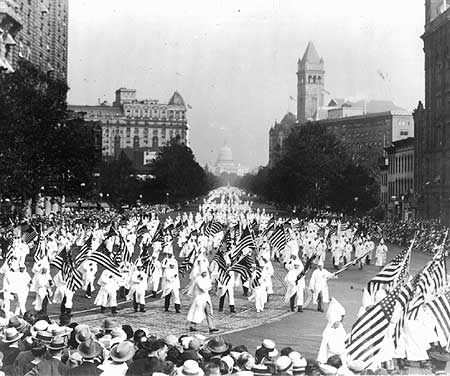
Teabagger ancestors

I keep thinking that the 9/12 teabagger rally in Washington DC reminded me of some other major public event in DC? I'm trying to narrow it down.

Let's think...

Nearly all white? Check.
Funny costumes? Check.
Lots of ignorant Southerners? Check.
Patriotic flag-waving? Check.
Overt racism? Check.
Concerned about wanting to "take back our country"? Check.
Intimidation by the threat of violence? Check.

Now I think I remember the event I was thinking of...


13 September 2009

A Trust Betrayed

I watched the President's speech on health care Wednesday. During it, I wondered to myself "How did we get to this place? Why is this even necessary?" Despite an improvement in public opinion regarding health care reform after the speech (and presumably a result of it), I still believe that the prospects for true health care reform are circling the drain ("true" meaning a public option, physician and hospital payment reform, significant measures at cost control, etc.). But why? In my opinion, it comes down to trust. A trust that was misplaced. A trust that was betrayed.

President Obama trusted Congress. In the opinion of some, he "overlearned" the lesson's of President Clinton's failure at achieving health care reform in the 90s. Instead of dictating a finished bill, he turned the process of actual policymaking - "legislating" - over to Congress, which is, according to our system, a "legislature." He trusted them, including significant majorities of Democrats in both the House and the Senate, to take care of working out the messy details of policy, armed with their collective experience and the expertise of witnesses and staffers. He trusted them to look beyond narrow electoral advantage, to ignore armies of lobbyists and dumptruck loads of special interest money squeezing through every crack in campaign finance law, and to have a broader vision for themselves and their country than the next two to six years. He trusted them to think in terms of the interests of ordinary Americans, and forget partisanship, sectionalism, and personal aggrandizement. That trust was misplaced and betrayed.

President Obama trusted Republicans too. He did not order Congressional Democrats to pass health care reform without consulting Democrats, or by using parliamentary procedure to make it happen without the need for Republican votes. He trusted that the Republicans would recognize the way the wind was blowing, after having been handed significant defeats at nearly every electoral level. He trusted them to engage in constructively building a solution for America's health care system, and in particular, a solution that would actually solve the problems of access, cost, and quality, instead of solving their credibility and loyalty problems with a couple hundred deranged constituents back home. He trusted them to be true to their political principles, but also to be true to the charge they were given to seek the common welfare of Americans. In short, he trusted them to act like adults. That trust was misplaced and betrayed.

Finally, President Obama trusted the American people. He trusted them to be intelligent consumers of information-- to not believe every thing that they saw on the TV, in their e-mail, or on a blog post. He trusted them to not make decisions based on mere rumor and innuendo. He trusted them to be broad-minded and open-hearted, to be concerned about the welfare of their fellow Americans as much as they would be concerned about the welfare of their siblings or cousins. He trusted them to not give in to cheap forms of public discourse and to not participate in a degradation of the national political atmosphere. That trust was also misplaced and betrayed.

This trust was lightly given, handed over despite no previous evidence of any of its recipients being trustworthy. I am not one generally disgusted by legislative politics (the "sausage-making"), but I am beginning to think differently. I see little reason to believe that Congress as a whole, despite the good intentions of a significant plurality of its members, to make necessary changes on the big issues in ways that would significantly benefit large portions of the American populace. And the American people? When they happen to get something right (electing Obama), it is practically a matter of dumb luck. To paraphrase The Dark Knight, President Obama "thought we could be decent men in an indecent time." I remain unconvinced.

30 August 2009

The Future: A Speculation

Take heed of the above title. The following is written primarily in the spirit of speculation rather than any confident prognostication. My grades in college macro- and micro-economics were not high enough for anyone to take what I am about to write without a large dose of salt.

We are now 21 months into the current recession (adopting the estimate that the recession began in December 2007). Some economists and pundits have interpreted a number of key economic indicators and measures to mean that we may have begun to emerge from the recession, or at least are approaching the bottom. Note the number of qualifiers in the previous sentence. It also appears that foreign economies have also begun to emerge from the global recession.

I am heartened by this news, and continue to be optimistic that the global economy will experience a measure of recovery throughout the remainder of this year and will be well on its way back to normalcy sometime in 2010, largely due to the efforts of political and economic leaders who intervened to avert a more serious crisis.

Nevertheless, I have lingering concerns about the employment prospects for the near and long term future. I will point you to two articles, both in the spirit of serious reflection, but one obviously a little more fanciful than the first. See here and here.

The first article, from The New Republic, notes the potential for a "jobless recovery," the concept that businesses and industries may return to former levels of activity, but without rehiring many of the workers who were fired during the worst part of the recession. I tend to agree with this prediction. I believe that recovery may be slow going at first, and that employment will lag far behind other indicators of economic progress. Some firms may return to previous levels of activity, but will have grown accustomed to doing more with less. Those who remained employed will have become very productive in their efforts to impress managers and keep their jobs (I can personally attest to this). Therefore, we will not see firms rehiring at former levels. Of particular concern is that the major driver of the American economy, consumer purchases, may remain lower for the foreseeable future. (See here). Without consumer purchasing as a driver, both here and abroad, major commercial businesses are unlikely to invest heavily in additional employees. If the American economy does not find another key driver of progress (green energy is generally thought to be the most likely candidate), look for sustained high unemployment for many years to come.

The second article, from the Washington Post, reflects on the growing (and coming) displacement of workers with computers and other machines. This is often a great boon to most of our lives, due to increased convenience and less human error (think of an ATM or making plane reservations online). However, it comes at a cost. Those ATMs replaced real humans who were bank tellers, and websites like Travelocity and Expedia practically decimated the demand for human travel agents. To put it crudely, the ongoing march of technology will make large numbers of Americans unnecessary and unemployable in the economy. The difficult decision is what comes next. Faced with a large underclass of unemployables (who are growing older due to better medical care), the stark choices presented us will be: higher (and more progressive) taxes or let them starve. Taxing the haves at high levels in order to redistribute to the poor is, of course, a matter of the social contract, but also a means to maintain social order. Nevertheless, it will be difficult and controversial.

I don't mean the above ruminations to be a downer. I do not consider myself to be one of the doomsayers, constantly afraid of my own shadow (and those of others) and seeing the end of the republic around every piece of negative news. Nevertheless, I believe that the near- and long-term future will present us with a stark set of choices about how we will react to the plight of our countrymen, and it is one that our political and popular discourse is ill-adapted to handle well.

26 August 2009

RIP Sen. Ted Kennedy

There are going to be many obituaries and eulogies for the late Sen. Edward M. Kennedy. This will not be one of them. It would best serve us (and perhaps best please him) that, in the words he spoke in a eulogy for his assassinated brother Robert, he "not be idealized, or enlarged in death beyond what he was in life; to be remembered simply as a good and decent man, who saw wrong and tried to right it, saw suffering and tried to heal it, saw war and tried to stop it."

In the days, weeks and months to come, more nuanced reflections on his life will become increasingly common. His many personal failings will become a particular focus for some. Already, in some less civilized portions of American society, this has already begun to take place. For now, I am content merely to list what I found today as this man's incredibly long list of legislative accomplishments.

  • Federal Election Campaign Amendments of 1974 - contribution limits and public financing for presidential elections (post-Watergate)
  • COBRA - extending employer-based health insurance after leaving a job
  • Americans with Diabilities Act - set new standards for accessibility of public facilities for persons with disabilities; prohibit discrimination in employment on the basis of disability
  • SCHIP - provide public health insurance to low-income children
  • Mental Health Parity Act - equalize treatment of mental health issues in health insurance
  • HIPAA - allowed employees to retain insurance when moving to a new job; protection of personal health information
  • Ryan White AIDS Act - provide assistance to states who operate programs designed to help AIDS patients
  • INA Act of 1965 - ended quota system in immigration favoring northern Europeans
  • National Cancer Act of 1971 - quadrupled the amount of federal research funding for cancer treatment
  • Title IX - equal funding for men's and women's sports on college campuses
  • Blocking Robert Bork's nomination to the Supreme Court - basically every good thing that has happened judicially over the past 20 years
  • National Teachers Corps - the predecessor of Teach for America
  • Anti-Apartheid Act - banned purchase of certain goods from South Africa under apartheid
  • Civil Rights Act of 1991
  • National and Community Service Trust Act- created Americorps to expand volunteerism and provide grants to students who volunteer after college
  • Two increases in the minimum wage
  • Head Start - providing meals and early education to underprivileged pre-school children
  • WIC - food assistance to low-income women and children
  • Meals on Wheels - federal program delivering found to homebound senior citizens
  • Individuals with Disabilities Education Act - free education to children with disabilities
  • Lowering the voting age to 18
  • Refugee Act - provision of humanitarian assistance, resettlement, and asylum to foreign refugees
  • Civil Rights Commission amendments - expanded CRC's jurisdiction to discrimination on the basis of disability
  • Creation of MLK Jr. Day
  • Lilly Ledbetter Fair Pay Act - allowing persons to sue for past wages if they have been the victim of unequal pay on the basis of gender discrimination
  • Increased access for the disabled to polling places
  • Family and Medical Leave Act- provided up to 12 weeks unpaid leave for family emergencies or newborn infants
  • FHA amendments to help the disabled - prohibiting discrimination against the disabled in housing
  • Even Start - early education and literacy for underprivileged children and families
  • Fuel assistance for low-income families
  • Strategic Arms Reduction Treaty - cut in half the nuclear arsenals of the US and Soviet Union
  • Removal of prohibition on female combat pilots
  • Direct student loans from the federal government
  • Temporary Assistance to Needy Families - welfare-to-work assistance
  • Gulf Coast Recovery Act - emergency funding for recovery efforts in the wake of Hurricane Katrina
  • PROTECT Act - enhanced Amber Alert
  • No Child Left Behind - federal standards in education (initially supported, but never fully funded, much to Sen. Kennedy's dismay)
  • Genetic Information Nondiscrimination Act of 2008
  • Family Opportunity Act of 2006 - allows states to expand Medicaid coverage to special needs children
  • Eliminated the poll tax from the Voting Rights Act of 1965
  • Violence Against Women Act - allowing battered women to move freely and establish residence without their husband's permission
  • 1994 Crime Act - put over 100,000 additional police on the streets of American cities
  • Foreign Intelligence Surveillance Act - regulates the government's use of electronic surveillance
The common thread of course is that most of Senator Kennedy's principal legislative achievements were on behalf of people very different from himself-- the disabled, the poor, the jobless, the victims.

The chief parlor game in Washington D.C., and in newsrooms around the country, tonight and for the next several weeks, is whether Kennedy's death will make health care reform more or less likely. For what it is worth, my hope, wish and anticipation is that this will be the final push needed to make serious health care reform happen. The irony will be that the cause for which Senator Kennedy lived and fought so long will be the one he had to die to achieve.

23 August 2009

What I Haven't Seen in a Very Long Time

See here (and then follow the video link)

Thursday's press conference by the Scottish Minister of Justice Kenny MacAskill regarding the release of alleged PanAm 103 bomber Abdelbaset Al-Megrahi left me a little shocked.  Personally, I am agnostic regarding the release of Al-Megrahi to Libya on "compassionate" grounds.  I would have been happy either way.


The shocking thing was the eloquence, bespeaking careful deliberation and attention, with which Mr. MacAskill announced the decision for Al-Megrahi's release.  I have rarely seen its like on that side of the pond or on this one.  The detailed and thoughtful manner in which Mr. MacAskill explained this decision indicates that he takes his audience (primarily the Scottish and wider British polity, but also the international community) seriously as an intelligent and equally thoughtful consumer of information and participant in the social and political life of the nation.  It is altogether refreshing to see a politician and leader not think and speak in easily consumable soundbites, which taken together may not add up to saying very much at all-- essentially talking down to us as passive recipients of information.  It is even more remarkable given that, in his capacity as a Cabinet Minister in the Scottish Parliament, Mr. MacAskill is unelected (he is an elected member of the Scottish Parliament however).


Regardless of the merits of the decision (Al-Megrahi's reception in Libya on Friday seems to have put Mr. MacAskill's decision in a very poor light), the way in which it was received by British and American policymakers was predictable and useless, even if the release of Al-Megrahi turns out to have been in poor judgment.  Mr. MacAskill handed us a clear opportunity to have a meaningful dialogue about the nature of terrorism, the proper handling of terrorist suspects and those convicted of terrorism, and the limits of current anti-terrorism policies here and in the UK.  That invitation was shoved back in his face like a cream pie.

06 August 2009

Stupidity, self-deception, and charity

Hearing or reading things like this (or this) continue to trouble me profoundly. It is tempting to believe that these are problems of simple ignorance-- problems that, with a sufficiently large bullhorn, can be remedied with simple but forceful education. However, after recently finishing Robert Wright's The Moral Animal, a mid-1990s study on evolutionary psychology, I have come to suspect that their is something deeper and more firmly entrenched at work.

The human capacity for self-deception is well...practically limitless.  But if, as I believe, most of us pride ourselves on searching for and accepting "truth," why is their self-deception?  To put it simply, it helps (or helped) us reproduce better, in two ways.  The simple version of the argument goes as follows: Under Darwinism, the (unconscious?) goal of organisms is to perpetuate their genes through their offspring.  Males in almost all species, who can conceivably reproduce with many females during any reproductive cycle, have the ability to have many, many more offspring over their lifetime than do females, who are generally burdened with gestating and raising the offspring, which limits their lifetime fertility.  Thus males seek after raw quantity of offspring, while females focus more on the quality of the few offspring they are able to produce, hoping that an achieved fitness will enable those offspring to reproduce prodigiously in future generations. 

The first reason for which self-deception may have evolved has to do with how females go about converting their few offspring into worthy future reproducers.  Females primarily pursue quality of offspring through male parental investment (MPI).  A male's MPI will likely inhibit the number of other females with which he could reproduce.  Thus, a male has an incentive to deceive the female regarding the level of MPI he is willing to provide.  In response, females would have likely developed a mental mechanism to detect deception.  But it is the male's counter-measure which is truly intriguing.  At some point, males may have developed a mechanism which heightened the sincerity of their deception by deceiving the males themselves regarding their less-than-noble intentions.  Being utterly convinced of their intention to provide a high level of MPI enabled those males to be utterly convincing to females.  Ergo, those males who could self-deceive reproduced more than those males who did not possess the new fangled mental equipment.  (Note that over a period of thousands of years, the mental machinery for deception, self-deception, and deceptiveness detection would have spread through both males and females in the population).  Whew, that took longer than expected.

The second reason for which self-deception may have evolved also involves sexual selection.  Under this theory, men are better able to achieve status and power through deception, or rather deception is one apt tool among many that males (and females) are able to call upon to achieve status and power.  Status and power translate into higher reproductive potential in males.  Again, self-deception enabled the ambitious to be more able deceivers, and thus to achieve status and power more readily.

Now, what was all this about?  My point, going back to the introduction, is that at some point in our evolution, human beings developed a capacity for self-deception.  Originally, this self-deception was designed for purely reproductive purposes.  It may still serve that purpose or it may not.  However it is unlikely to have become dormant merely because its usefulness has declined.  (Note: This is because this capacity would have taken thousands and tens of thousands of years to develop through natural selection.  It would not disappear in the few hundred years since our species outgrew its usefulness, if we have at all).  Therefore, nearly all humans would likely possess this unconscious capacity to deceive ourselves, all the better to deceive others.  I make the point about self-deceptions unconscious nature to show that self-deception is not malicious, or at least not intentionally so.

So I pointed out a couple of examples in the first sentence of incredibly bone-headed behavior as evidence for human being's capacity for self-deception.  I say this without sarcasm or malice, because being a human trait, self-deception is one with which we are all afflicted.  It actually inspires me to be more charitable towards those with whom I disagree.  Many of them believe some things which are false (and even demonstrably so, not just a mere difference of opinion).  However, they believe them for powerful reasons that have little or nothing to do with the truth or falsity of the idea...and they are not even aware of it.  The phenomenon we call cognitive dissonance would have arisen as part of our capacity for self-deception, in fact to deepen it.  Self-deception is still a tool in the search for status and power.  Believing certain false ideas because of self-deception, and therefore being a very believer in that idea, may have little utility in the larger population or among other communities, but could be incredibly useful in signaling one's status or potential in one's own community.  For example, take the "birthers."  I can predict, with near certainty, that there are few, if any birthers, on the faculties at Harvard or Yale.  Believing such a thing, or at least publicizing it to others, would cause an extreme loss of face, resulting in loss of standing in the intellectual community.  (This does not, of course, preclude faculty members at Harvard and Yale being self-deceived in other areas, which actually contribute to their status and standing).  However, a recent poll showed that 53% of Southerners polled said they did not believe or were not sure that President Obama was born in the U.S.  For a variety of factors, involving politics, racial history, and our baser emotions, being a "birther" may have some utility for some people in the South.

As I alluded to before, humanity's capacity for self-deception is a double-edged sword.  I can point fingers at the absurdities that other folks believe, while being ignorant of the many ways in which I have deceived myself into believe a host of other half-truths and silliness.  In sum, I am encouraged by Wright's admonition towards the close of The Moral Animal, asking us to be more generous with one another and more introspective and thoughtful about our own ideas.  The self-deceived need not remain so.

04 August 2009

Townhall ambushes

What may end up being the big news story of the week ( and perhaps the whole month of August) is the disruption of House members' townhall meetings and other public gatherings with their constituents by "teabaggers" and other assorted conservative activists. By their own admission and by order of their organizers, the goal of such activists is to disrupt these events and prevent communication between the Representative and his or her constituents, particularly as it regards health care reform.

I support the right of all citizens to peacefully (and sometimes not so peacefully) petition their government and make their voices heard. However, this behavior is absolutely juvenile. It is the equivalent of sticking your fingers in your own ears (and the ears of those standing around you) and going "Lalalalalala...I can't hear you!" The activists' goal is not to move the debate in one direction or another or to influence the legislators with alternative proposals. Their purpose is to stop the process dead in its tracks and frankly, to intimidate the legislators among their own people. It is mobocracy and an attempt at governing through fear. If the "teabaggers" have some positive and constructive suggestions for legislative enactments that actually accomplish some of what needs to be accomplished in health care reform (more universal coverage, lower cost, etc.), by all means, share it. Share it loudly if need be. But let's put this childish and foolish behavior behind us.

03 August 2009

Red vs. Blue Economies

Ezra Klein (him again) and Andrew Sullivan (yes, I am a fan) both have stories (here, here and here) today on Ross Douthat's column in the NYT, in which Douthat argues that red-state economic models (specifically Texas, where I currently reside) may be more useful for emulation than blue-state economic models (in particular California). As you might expect, that argument is somewhat against the weight of the evidence.

California is a mess, no question about that. The housing market and unemployment are quite bad and the recent budget cuts are going to be quite painful for many Californians.

It is also true that Texas has responded better than most to the current recession. Last time I checked, unemployment was lower than the national average. In my own experience, some people here have lost their jobs but the consumer and housing markets have remained relatively healthy in spite of all the bad news. However, there is a price to be paid in all this. In terms of a social safety net, Texas is a quite miserly. Its levels of poverty and lack of health insurance (both for the general population and specifically for children) are among the worst in the nation. (See Klein's chart here). Texas has some special challenges-- in particular the large immigrant population-- but of course that is shared by California as well. Texas also has natural resources and industries that contribute a goodly share of the state's tax base, but somehow it has been difficult to translate these revenues into benefits and services for the most disadvantaged. Part of it is a question of priorities-- while I noted yesterday that Americans are more individualistic than Europeans, Texans are the epitome of this attitude.

Getting away from these two states, the bottom line is the twenty-five most prosperous states (by average income) are overwhelmingly blue states (21-4 in favor). The least prosperous states...well why belabor the point? But all of this obscures the real issue. The health of a state's economy cannot be measured solely by its per capita output or income, or the average price of a home. There must be room for a metric which reflects how broadly the benefits of prosperity are shared. No doubt this may reorder the list somewhat, but we have to move away from the abstraction that it is the states that have $X in income and remember that the ones truly suffering are not states, but individuals, families, and children.

12 December 2008

Nuremberg it ain't

This week brought the latest development in the prosecution of five Blackwater private security guards for the shooting deaths of 17 civilians in Baghdad in 2007.  The development: the formal unsealing of the Justice Department's indictment of the guards and the surrender of the accused to federal authorities.

What's my particular interest in this case? The guards chose to surrender themselves in Salt Lake City, Utah.  Why Utah, you ask?  Great question.  Let's review the geography:

Venue ordinarily reserved for prosecution of crimes committed overseas: Washington, D.C.
Place where atrocities occurred: Baghdad, Iraq
Place where accused's employer has its HQ: Moyock, North Carolina
Homes of the accused:
  • Dustin Heard, Knoxville, TN
  • Evan Liberty, Rochester, NH
  • Nick Slatten, Sparta, TN
  • Paul Slough, Keller, TX
  • Donald Ball, West Valley, UT
Oh so there it is.  Out of all of the places a trial like this could be held, they picked the home state of one defendant.  I don't want to go into all the niceties of "minimum contacts" and personal jurisdiction, but surrendering and asking for trial in Utah is certainly legal, at least in the loosest sense of the word.

But why surrender in Utah? News sources are reporting that it is in order to be in a "more conservative, pro-gun" jurisdiction.  Puh-leeze.  Utah fits that description, clearly, but aren't Tennessee, Texas, and North Carolina also full of hicks clinging to their guns? (Disclosure: I lived in NC for 26 years--and my entire family still resides there-- until I moved to Texas, so I do not think I am speaking from ignorance.)  And any of them would be closer than the place where the trial actually ought to be held- Washington, DC.

So it can't just be conservatism and "pro-gunness," right?  What else might there be?  From the AP, we learn that the guards wanted a jury pool "more likely to support the Iraq war."  In 2006, Utah was one of only three states (including its neighbors in Idaho and Wyoming- does anybody actually live in Wyoming?) where not-my-President Bush had a 50%+ approval rating.  In 2007, it became the only state with that lofty distinction.  However, at the same time support for the Iraq War (and Pres. Bush's handling of it) was only at 41%, right around the time that President Hinckley made some negative remarks about the consequences of the war.  Granted, at the exact same time, support for the war among the broader American populace was at 23%.  Behind.  The.  Curve.  Its part of that "dangerous culture of obedience" that former SLC Mayor Rocky Anderson identified that same year.  When Utahns are becoming sought for their propensity to side favorably with mercenaries and war criminals, we are in dangerous territory.  (And yes, I know that not everybody in Utah is Mormon.  But the 41% that still supported the Iraq War in 2007 definitely are, and those are the people that the defense attorneys are hoping will make it on the jury.  The rest of them just finished voting for Obama.)

Utah- now known for the greatest snow on earth, Sundance, Mormons, natural beauty, and a lack of accountability for "war crimes."