02 November 2009

Demise of the BYU Women's Research Institute

On October 29, 2009, Brigham Young University announced that it would be closing the Women's Research Institute, the program which housed the university's women's studies minor. I am fortunate enough to know someone who was previously affiliated with the WRI -- my wife Ariel, who taught at the WRI in the summer of 2006. I have invited her to share her thoughts on this event.

Three years ago, I had the opportunity to take a break from my Ph.D. program at Duke and spend a summer as visiting faculty at the Women’s Research Institute at Brigham Young University. Bonnie Ballif-Spanvill, director of the Women’s Research Institute, invited me to teach Introduction to Women’s Studies, the core course requirement for the women’s studies minor, during BYU’s spring term. In need of both teaching experience and money, I agreed to teach the course even though I had a number of reservations about doing so. First of all, I had been a student at BYU for 5 years and had never even known they taught women’s studies courses at all. Was anyone going to enroll? But more importantly, I was fresh out of a graduate women’s studies course at Duke, an institution with a “real” women’s studies department and an active feminist agenda. I did not want to teach anything but a serious women’s studies syllabus—something I could teach at any university that would deal with touchy issues such as female sexuality. And was I even allowed to say “feminism” at BYU without ending up in my bishop’s office? Would it be like my previous two summers of teaching Book of Mormon in the religion department, where veteran religion professors regularly snuck into the back of my class to evaluate my orthodoxy?


I was glad to find that my fears were largely unfounded. Ballif-Spanvill, a highly intelligent and well-educated woman with the kindly appearance of an elementary school teacher, had mastered the art of treading lightly around the powers that be in order to keep the WRI largely autonomous. Because of her political savvy, the WRI was a haven of academic freedom for feminist scholars such as myself. While there, I was given free reign over what I could teach, the materials I could use, and the topics I could discuss. Ballif-Spanvill even tried to help me get through the BYU “honor code” computer filters to conduct my research on pornography. But what amazed me most about the WRI is the freedom I felt there not only as a feminist but also as a LDS scholar. While discussing issues such as sexual abuse, lesbianism, body image, and sex work, I was able to speak more openly and confidently about women’s issues than I ever had before because of the religious demographic of the classroom. While we discussed many of the same subjects that would have been part of the curriculum at any other university, there was also a place for testimony and for the reconciliation of fact with faith. It was a unique experience and one that I will never forget.


I had toyed with the idea of returning to the WRI one day when BYU was willing to put more resources into women’s studies and would finally fund some regular professorships in the WRI. Instead, the administration has decided to eliminate the WRI altogether, supposedly “streamlining and strengthening” the women’s studies minor by relocating it to the sociology department. I am skeptical. While the elimination of such a relatively-unpopular minor may seem like the logical choice in the midst of a serious economic recession, the administration of BYU must consider the long-term results of this choice. Women’s studies is not only a department but a symbol of social progress and a commitment to equality at universities around the world. It can be of no coincidence that the WRI was founded in 1978, only shortly after LDS African Americans were allowed to hold the priesthood and in the midst of debate over the Equal Rights Amendment, an era in which both BYU and the Church were seeking ways in which to express their dedication to racial and gender equality. Has the need for such visual symbolism ceased in this time of Proposition 8? Hardly.

In emphasizing the symbolic value of the WRI, I do not wish to demean the actual academic value of women’s studies at BYU. The WRI has served over the past thirty-one years to pursue specific goals central not only to the feminist agenda but also to the Gospel of Jesus Christ: to promote the education of women, to recognize and eliminate the exploitation of women, and to end violence and abuse of women. In light of these considerations, one might even argue that the goals and achievements of the WRI are of greater social, political, and even eternal importance than those of most other departments at BYU. Yet in eliminating the WRI and burying the women’s studies minor in the sociology department, the administration is marginalizing these aims and reinforcing to the world (once again) that money-making lawyers and accountants glorify God better than engaged citizens sensitized to social injustice and committed to change.


21 September 2009

Book review- Devil's Gate: Brigham Young and the Great Mormon Handcart Tragedy

I just finished David Robert's Devils Gate: Brigham Young and the Great Mormon Handcart Tragedy and thought that I would give it a brief review. This was my first book-length treatment of the handcart pioneers. The depth of my familiarity to this point has been the various classic anecdotes shared in a thousand talks and General Conference addresses since the pioneers first reached Utah. So, I found myself with a lot to learn.

For anyone coming after me who wants to read this book, I offer the following warning. Read the first chapter, then skip to about page 78. The author, who has written several books previously on a variety of topics relating to the American West, but without any previous experience or expertise in Mormonism, gives us, in the early part of the second chapter, his own personal views on the life and work of the Prophet Joseph Smith. His view takes the stance that between two reasonable and plausible interpretations of various acts of Joseph Smith, one that makes him look like a good person, and one that makes him look like a no-good scoundrel, Roberts inevitably chooses the latter on every occasion. Roberts still pretends that Fawn Brodie's No Man Knows My History is the definitive biography of Joseph Smith. Writing in 2008, acting not only as if Rough Stone Rolling is not at least the former's equal in scholarly rigor, but acting as if RSR simply did not exist, is inexcusable from a historian's point of view. While Robert's opinions of Joseph Smith may not be supported by RSR, the arguments made in that book must at least be dealt with.

Perhaps more importantly, Joseph Smith's story is ultimately irrelevant to the story of the handcart pioneers. Obviously, the visions of the Prophet Joseph Smith point towards the ultimate motivation of the handcart pioneers, but Joseph Smith was not responsible for any of the decisions that lead to the handcart disaster. He did not make the decisions, nor do any of the principles which he taught illuminate the reasons for the various acts of mismanagement that lead to the deaths of so many.

Which brings me to the author's ultimate argument: that Brigham Young was responsible for the deaths of the handcart pioneers, and that he ordered them to their deaths because he valued life so cheaply. In the author's defense, I will point out that this is at least John Taylor's estimation of Young's motivation. In a letter responding to Young's accusation of overspending on the provisions of the handcart pioneers in New York, Taylor lowers the condemnatory hammer, sarcastically stating that he was unaware that money was to be valued more highly than lives in the handcart enterprises. (I apologize that I do not have the quote in front of me, but the book was already returned to the library). However, other than this single quote from Taylor, who was in NY at the time that the serious decisions regarding the handcart journey were being made, the author provides little in the way of evidence for Young's callousness. What he does show is that Young was likely misinformed, overly optimistic, and overzealous regarding the handcart pioneers. This assessment is one I can get behind. Brigham Young was overly optimistic about the time it would require for the handcart pioneers to cross the plains and how much the members of the teams could handle on a daily basis. He was anxious to get the handcart pioneers to Zion as quickly as possible, which probably lead him to discount some opinions contrary to his position. And he was certainly surrounded by other parties at least as zealous as himself, encouraging some careless decision-making. However, none of this proves callousness or a lack of respect for human life. In fact, Brigham Young's eventual order for a dramatic rescue of the handcart pioneers (once their dire position was made clear to him by recent arrivals to the valley from the trail) tends to show the opposite. He may have been tardy, but not unconcerned.

At one point, the author takes issue with an exhibit from a church history site which depicts the unfolding of the handcart tragedy as a series of falling dominoes, representing the numerous circumstances that put the handcart pioneers in danger. In this, he is correct. Various of those "circumstances" were not in fact circumstances at all, but were the result of multiple human decisions, some of which were not taken in full light of the facts or with the proper goal of preserving and safeguarding human life in mind. To paraphrase the famous quip regarding guns, snow, hunger and cold did not kill the handcart pioneers, poor decision-making did.

Roberts finishes his story of the Martin and Willie companies with about 50-75 pages left in the book. One of the final chapters is one of the more interesting, and deals with Roberts' tour of various church history sites along the Mormon Trail. Roberts opines that the missionary-docents misrepresent some aspects of the handcart history (they probably do) and that the practice of Mormon youth recreating portions of the handcart journey over a short distance probably does a disservice to the memory of the handcart pioneers by cheapening their suffering, which is in his mind the chief feature of the tale. Opinions on this may vary, and may be particularly vehement among those who have done a handcart "trek." However, it is certain that a journey of a couple of days, with adequate food and water on hand, in clement conditions, with emergency aid available, and stepping into a couple of "cow patties" along the way do not remotely equate to the handcart pioneer's months of suffering in cold and hunger, nearly no prospect of rescue or return, during which death stalked them at every turn. One can argue whether it was meant to encourage association with their experiences, reflection, loyalty, humility, or a mix of them all. In my opinion, this chapter is one of Roberts' more original contributions to the scholarship surrounding the handcart tragedy.

For member of the Church of Jesus Christ of Latter-day Saints, there is a familiar anecdote with which anyone questioning the necessity of the handcart pioneer's sacrifice and the guilt behind any of their leaders' decisions must deal. I quote it in part below:
Some years after the Martin company made their journey to Salt Lake City, a teacher in a Church class commented how foolish it was for the Martin company to come across the plains when it did. The teacher criticized the Church leaders for allowing a company to make such a journey without more supplies and protection.
I was an old man sitting in the classroom listening, then I spoke out, asking that the criticism be stopped, ‘Mistake to send the Handcart Company out so late in the season? Yes. But I was in that company and my wife was in it. … We suffered beyond anything you can imagine and many died of exposure and starvation, but did you ever hear a survivor of that company utter a word of criticism? Not one of that company ever apostatized or left the Church, because everyone of us came through with the absolute knowledge that God lives, for we became acquainted with Him in our extremities.
......
‘Was I sorry that I chose to come by handcart? No. Neither then nor any minute of my life since. The price we paid to become acquainted with God was a privilege to pay, and I am thankful that I was privileged to come in the Martin Handcart Company.’
The argument here, in short, is that the sufferings of the handcart pioneers were necessary for the individual's salvation and ultimately, for the building up of Zion. Roberts notes and documents that one of the premises of this argument, that no member of the handcart companies ever apostatized, is false. Several members of the handcart companies, including some of their subcaptains, did ultimately apostatize, and their experience on the handcart trail contributed to that decision. Furthermore, those who died along the trail are not available to answer whether the handcart trek was worth it in their minds. Could the handcart pioneers have become acquainted with God's mercy and care without suffering what they did? Second-guessing from this distance seems imprudent. But some Saints obviously did. Pioneer companies and handcart companies besides the ill-fated Martin and Willie companies made it through with fewer deaths and injuries and their material contributions and testimonies too contributed heavily to the establishment of the Church in the Salt Lake Valley and throughout the West.

To sum up: I thought this book (besides the portion I recommend be excluded above) was a decent history of the handcart pioneers. My disclaimer of course is that I have read no others. My eyes were certainly opened to some of the excesses involved in the handcart enterprises and occasions where better decisions could ultimately have been made, saving the lives of hundreds, with no ill effects on the establishment of Zion. The author's bias against Mormonism and Brigham Young (though sympathetic to the pioneers) was clear from the beginning; but since an unbiased history could likely never be told, it is more important to be aware of the bias than to dismiss the book out of hand because of it.

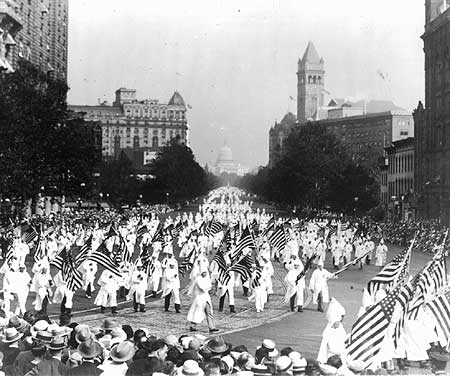
15 September 2009

Teabagger ancestors

I keep thinking that the 9/12 teabagger rally in Washington DC reminded me of some other major public event in DC? I'm trying to narrow it down.

Let's think...

Nearly all white? Check.
Funny costumes? Check.
Lots of ignorant Southerners? Check.
Patriotic flag-waving? Check.
Overt racism? Check.
Concerned about wanting to "take back our country"? Check.
Intimidation by the threat of violence? Check.

Now I think I remember the event I was thinking of...


13 September 2009

A Trust Betrayed

I watched the President's speech on health care Wednesday. During it, I wondered to myself "How did we get to this place? Why is this even necessary?" Despite an improvement in public opinion regarding health care reform after the speech (and presumably a result of it), I still believe that the prospects for true health care reform are circling the drain ("true" meaning a public option, physician and hospital payment reform, significant measures at cost control, etc.). But why? In my opinion, it comes down to trust. A trust that was misplaced. A trust that was betrayed.

President Obama trusted Congress. In the opinion of some, he "overlearned" the lesson's of President Clinton's failure at achieving health care reform in the 90s. Instead of dictating a finished bill, he turned the process of actual policymaking - "legislating" - over to Congress, which is, according to our system, a "legislature." He trusted them, including significant majorities of Democrats in both the House and the Senate, to take care of working out the messy details of policy, armed with their collective experience and the expertise of witnesses and staffers. He trusted them to look beyond narrow electoral advantage, to ignore armies of lobbyists and dumptruck loads of special interest money squeezing through every crack in campaign finance law, and to have a broader vision for themselves and their country than the next two to six years. He trusted them to think in terms of the interests of ordinary Americans, and forget partisanship, sectionalism, and personal aggrandizement. That trust was misplaced and betrayed.

President Obama trusted Republicans too. He did not order Congressional Democrats to pass health care reform without consulting Democrats, or by using parliamentary procedure to make it happen without the need for Republican votes. He trusted that the Republicans would recognize the way the wind was blowing, after having been handed significant defeats at nearly every electoral level. He trusted them to engage in constructively building a solution for America's health care system, and in particular, a solution that would actually solve the problems of access, cost, and quality, instead of solving their credibility and loyalty problems with a couple hundred deranged constituents back home. He trusted them to be true to their political principles, but also to be true to the charge they were given to seek the common welfare of Americans. In short, he trusted them to act like adults. That trust was misplaced and betrayed.

Finally, President Obama trusted the American people. He trusted them to be intelligent consumers of information-- to not believe every thing that they saw on the TV, in their e-mail, or on a blog post. He trusted them to not make decisions based on mere rumor and innuendo. He trusted them to be broad-minded and open-hearted, to be concerned about the welfare of their fellow Americans as much as they would be concerned about the welfare of their siblings or cousins. He trusted them to not give in to cheap forms of public discourse and to not participate in a degradation of the national political atmosphere. That trust was also misplaced and betrayed.

This trust was lightly given, handed over despite no previous evidence of any of its recipients being trustworthy. I am not one generally disgusted by legislative politics (the "sausage-making"), but I am beginning to think differently. I see little reason to believe that Congress as a whole, despite the good intentions of a significant plurality of its members, to make necessary changes on the big issues in ways that would significantly benefit large portions of the American populace. And the American people? When they happen to get something right (electing Obama), it is practically a matter of dumb luck. To paraphrase The Dark Knight, President Obama "thought we could be decent men in an indecent time." I remain unconvinced.

30 August 2009

The Future: A Speculation

Take heed of the above title. The following is written primarily in the spirit of speculation rather than any confident prognostication. My grades in college macro- and micro-economics were not high enough for anyone to take what I am about to write without a large dose of salt.

We are now 21 months into the current recession (adopting the estimate that the recession began in December 2007). Some economists and pundits have interpreted a number of key economic indicators and measures to mean that we may have begun to emerge from the recession, or at least are approaching the bottom. Note the number of qualifiers in the previous sentence. It also appears that foreign economies have also begun to emerge from the global recession.

I am heartened by this news, and continue to be optimistic that the global economy will experience a measure of recovery throughout the remainder of this year and will be well on its way back to normalcy sometime in 2010, largely due to the efforts of political and economic leaders who intervened to avert a more serious crisis.

Nevertheless, I have lingering concerns about the employment prospects for the near and long term future. I will point you to two articles, both in the spirit of serious reflection, but one obviously a little more fanciful than the first. See here and here.

The first article, from The New Republic, notes the potential for a "jobless recovery," the concept that businesses and industries may return to former levels of activity, but without rehiring many of the workers who were fired during the worst part of the recession. I tend to agree with this prediction. I believe that recovery may be slow going at first, and that employment will lag far behind other indicators of economic progress. Some firms may return to previous levels of activity, but will have grown accustomed to doing more with less. Those who remained employed will have become very productive in their efforts to impress managers and keep their jobs (I can personally attest to this). Therefore, we will not see firms rehiring at former levels. Of particular concern is that the major driver of the American economy, consumer purchases, may remain lower for the foreseeable future. (See here). Without consumer purchasing as a driver, both here and abroad, major commercial businesses are unlikely to invest heavily in additional employees. If the American economy does not find another key driver of progress (green energy is generally thought to be the most likely candidate), look for sustained high unemployment for many years to come.

The second article, from the Washington Post, reflects on the growing (and coming) displacement of workers with computers and other machines. This is often a great boon to most of our lives, due to increased convenience and less human error (think of an ATM or making plane reservations online). However, it comes at a cost. Those ATMs replaced real humans who were bank tellers, and websites like Travelocity and Expedia practically decimated the demand for human travel agents. To put it crudely, the ongoing march of technology will make large numbers of Americans unnecessary and unemployable in the economy. The difficult decision is what comes next. Faced with a large underclass of unemployables (who are growing older due to better medical care), the stark choices presented us will be: higher (and more progressive) taxes or let them starve. Taxing the haves at high levels in order to redistribute to the poor is, of course, a matter of the social contract, but also a means to maintain social order. Nevertheless, it will be difficult and controversial.

I don't mean the above ruminations to be a downer. I do not consider myself to be one of the doomsayers, constantly afraid of my own shadow (and those of others) and seeing the end of the republic around every piece of negative news. Nevertheless, I believe that the near- and long-term future will present us with a stark set of choices about how we will react to the plight of our countrymen, and it is one that our political and popular discourse is ill-adapted to handle well.